Modernizing merchant onboarding with AI to improve conversion
Modernizing merchant onboarding with AI to improve conversion
Making onboarding feel like talking to a bank representative
Role
Role
Product Designer
Team
Team
Product managers,
Sales team, Developers, CTO
Tools
Tools
Figma, HeyGen, ElevenLabs
Duration
Duration
3 months
about the company
What is Pollinate?
Pollinate is a fintech platform serving tier 1 banks and financial institutions. It provides a suite of configurable mini apps and merchant acquiring tools that enable banks to deliver seamless financial experiences to their merchants. Beyond customer-facing solutions, Pollinate also builds internal tools like sales agent, announcements, reporting and status tracking systems to help banks manage and support their merchant networks more effectively.
about the company
What is Pollinate?
Pollinate is a fintech platform serving tier 1 banks and financial institutions. It provides a suite of configurable mini apps and merchant acquiring tools that enable banks to deliver seamless financial experiences to their merchants. Beyond customer-facing solutions, Pollinate also builds internal tools like sales agent, announcements, reporting and status tracking systems to help banks manage and support their merchant networks more effectively.
about the company
What is Pollinate?
Pollinate is a fintech platform serving tier 1 banks and financial institutions. It provides a suite of configurable mini apps and merchant acquiring tools that enable banks to deliver seamless financial experiences to their merchants. Beyond customer-facing solutions, Pollinate also builds internal tools like sales agent, announcements, reporting and status tracking systems to help banks manage and support their merchant networks more effectively.

About the problem
Overview
Merchant onboarding is a universal challenge across banking and financial institutions. The process is standardised but cumbersome. merchants must complete detailed quotes for POS devices and other products, submit lengthy applications with business details, owner information, and banking credentials, upload financial statements and verification documents, sign agreements, and finally wait for provisioning. Each step is manual, disconnected, and requires re-entry of information. This friction creates significant dropoff, leaving banks with incomplete applications and merchants unable to access services. Hence we came up with AI Onboarding concept to make journey more intuitive and sleeker.
About the problem
Overview
Merchant onboarding is a universal challenge across banking and financial institutions. The process is standardised but cumbersome. merchants must complete detailed quotes for POS devices and other products, submit lengthy applications with business details, owner information, and banking credentials, upload financial statements and verification documents, sign agreements, and finally wait for provisioning. Each step is manual, disconnected, and requires re-entry of information. This friction creates significant dropoff, leaving banks with incomplete applications and merchants unable to access services. Hence we came up with AI Onboarding concept to make journey more intuitive and sleeker.
About the problem
Overview
Merchant onboarding is a universal challenge across banking and financial institutions. The process is standardised but cumbersome. merchants must complete detailed quotes for POS devices and other products, submit lengthy applications with business details, owner information, and banking credentials, upload financial statements and verification documents, sign agreements, and finally wait for provisioning. Each step is manual, disconnected, and requires re-entry of information. This friction creates significant dropoff, leaving banks with incomplete applications and merchants unable to access services. Hence we came up with AI Onboarding concept to make journey more intuitive and sleeker.
The challenge
Understanding the problem
We recognized that merchant onboarding across the industry needed modernization. The current process was built around manual, form-based workflows. Merchants were entering information that banks already possessed or that existed publicly, yet there was no intelligent layer to streamline this. This led us to a critical question: “How might we modernize merchant onboarding by introducing an AI layer that reduces manual friction while maintaining the rigor financial institutions require?”
The challenge
Understanding the problem
We recognized that merchant onboarding across the industry needed modernization. The current process was built around manual, form-based workflows. Merchants were entering information that banks already possessed or that existed publicly, yet there was no intelligent layer to streamline this. This led us to a critical question: “How might we modernize merchant onboarding by introducing an AI layer that reduces manual friction while maintaining the rigor financial institutions require?”
No sense of support
Merchants felt like they were navigating a bureaucratic process alone, with no guidance, assistance, or human touch throughout the journey.
Forms were too long
The entire onboarding process from quote to application to documents to signing required merchants to fill out extensive forms manually, creating fatigue and dropoff.
Redundant data entry
Merchants re-entered information that banks already possessed or that existed publicly, creating unnecessary friction and frustration.
The approach
Starting with quote
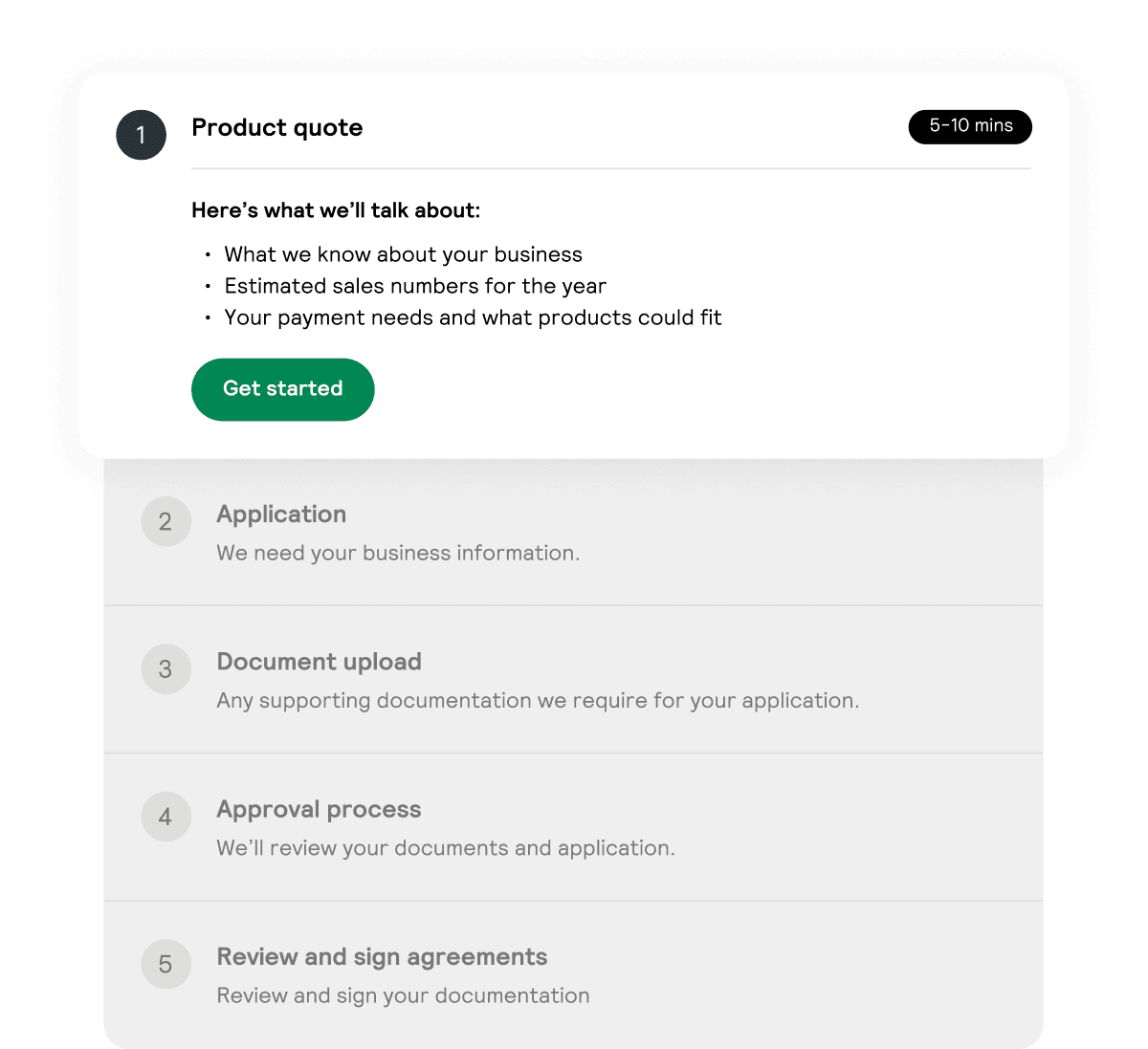
Merchant onboarding consists of five distinct modules. Rather than redesigning all five modules at once, we decided to start with the quote flow the entry point where merchants first engage. Quote is critical because it's where we understand the merchant's needs and can recommend products and add-ons effectively. By modernizing this stage with AI assistance, we could improve both conversion and product recommendation accuracy.
The approach
Starting with quote
Merchant onboarding consists of five distinct modules. Rather than redesigning all five modules at once, we decided to start with the quote flow the entry point where merchants first engage. Quote is critical because it's where we understand the merchant's needs and can recommend products and add-ons effectively. By modernizing this stage with AI assistance, we could improve both conversion and product recommendation accuracy.
The approach
Starting with quote
Merchant onboarding consists of five distinct modules. Rather than redesigning all five modules at once, we decided to start with the quote flow the entry point where merchants first engage. Quote is critical because it's where we understand the merchant's needs and can recommend products and add-ons effectively. By modernizing this stage with AI assistance, we could improve both conversion and product recommendation accuracy.
Solving the multi-store problem
How the AI path works
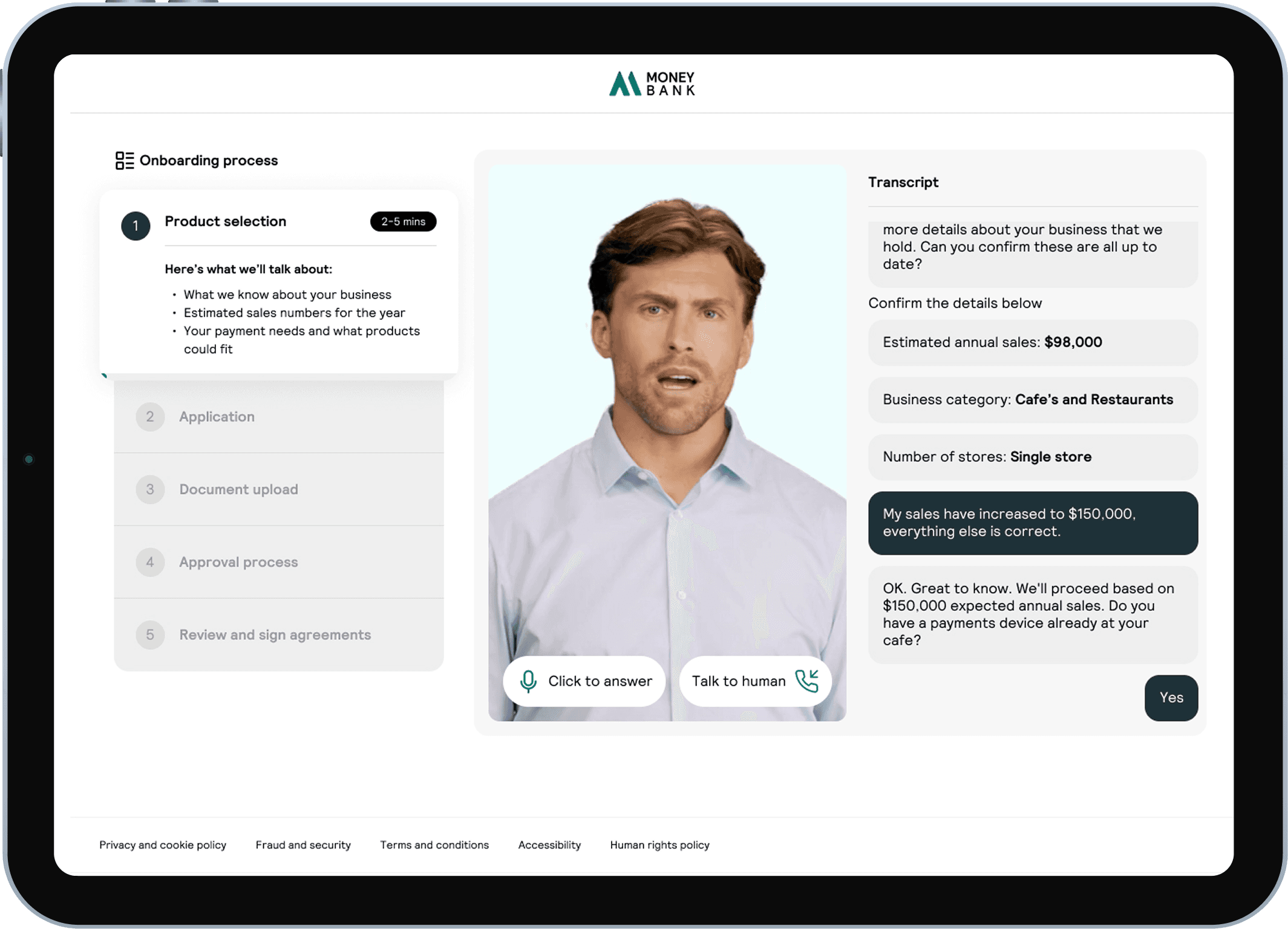
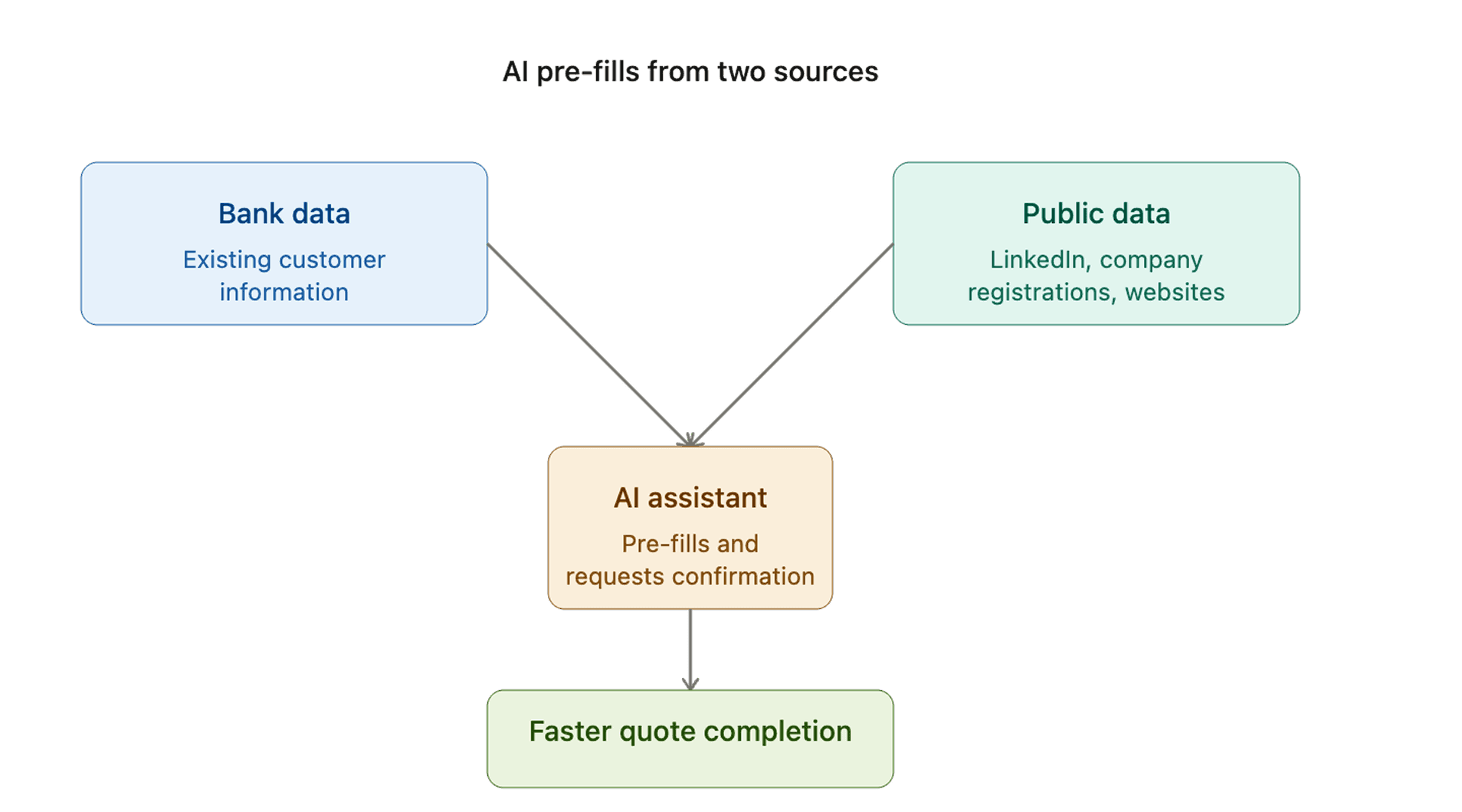
Merchants choosing the AI-assisted path interact with a conversational interface. The AI intelligently pulls data from two sources: the bank's existing customer information and publicly available business data (LinkedIn, company registrations, websites). Rather than asking merchants to re-enter everything, it presents confirmations and asks for only the information it's uncertain about. This approach maintains the rigor required for financial compliance while dramatically reducing the manual burden on merchants.
Solving the multi-store problem
How the AI path works
Merchants choosing the AI-assisted path interact with a conversational interface. The AI intelligently pulls data from two sources: the bank's existing customer information and publicly available business data (LinkedIn, company registrations, websites). Rather than asking merchants to re-enter everything, it presents confirmations and asks for only the information it's uncertain about. This approach maintains the rigor required for financial compliance while dramatically reducing the manual burden on merchants.
Solving the multi-store problem
How the AI path works
Merchants choosing the AI-assisted path interact with a conversational interface. The AI intelligently pulls data from two sources: the bank's existing customer information and publicly available business data (LinkedIn, company registrations, websites). Rather than asking merchants to re-enter everything, it presents confirmations and asks for only the information it's uncertain about. This approach maintains the rigor required for financial compliance while dramatically reducing the manual burden on merchants.
competitve analysis
Understanding the landscape
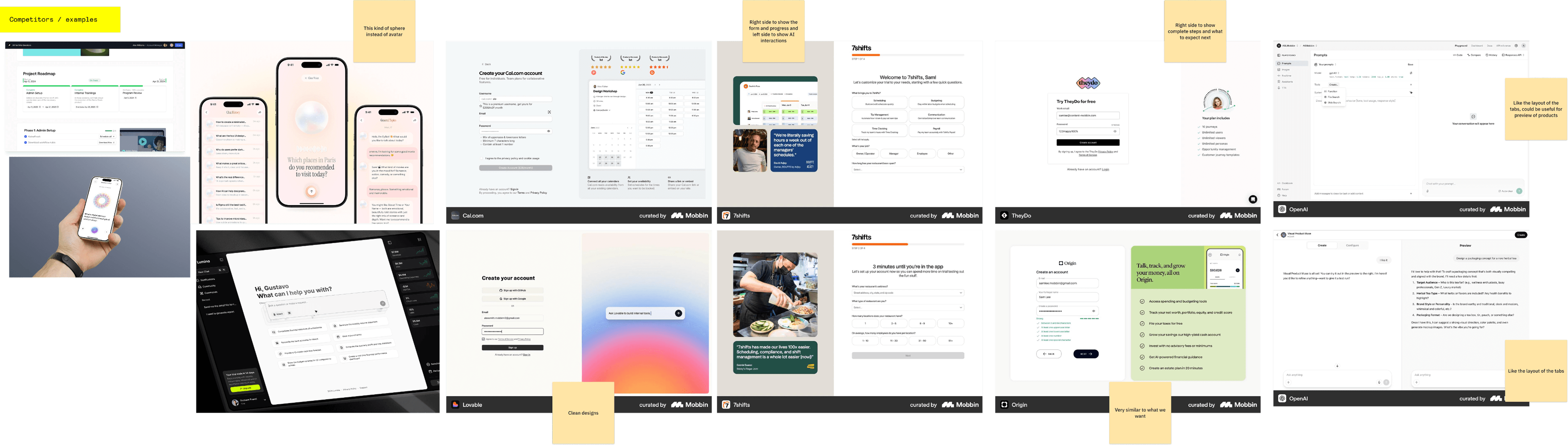
I started with competitive analysis to understand how other platforms were using AI in their solutions and what mental models existed around video and voice-based interaction platforms. This research informed both the interaction design and visual direction, giving us inspiration for how to make an AI-assisted experience feel natural and trustworthy.
competitve analysis
Understanding the landscape
I started with competitive analysis to understand how other platforms were using AI in their solutions and what mental models existed around video and voice-based interaction platforms. This research informed both the interaction design and visual direction, giving us inspiration for how to make an AI-assisted experience feel natural and trustworthy.
competitve analysis
Understanding the landscape
I started with competitive analysis to understand how other platforms were using AI in their solutions and what mental models existed around video and voice-based interaction platforms. This research informed both the interaction design and visual direction, giving us inspiration for how to make an AI-assisted experience feel natural and trustworthy.
Creating the vision
Storyboarding the merchant journey
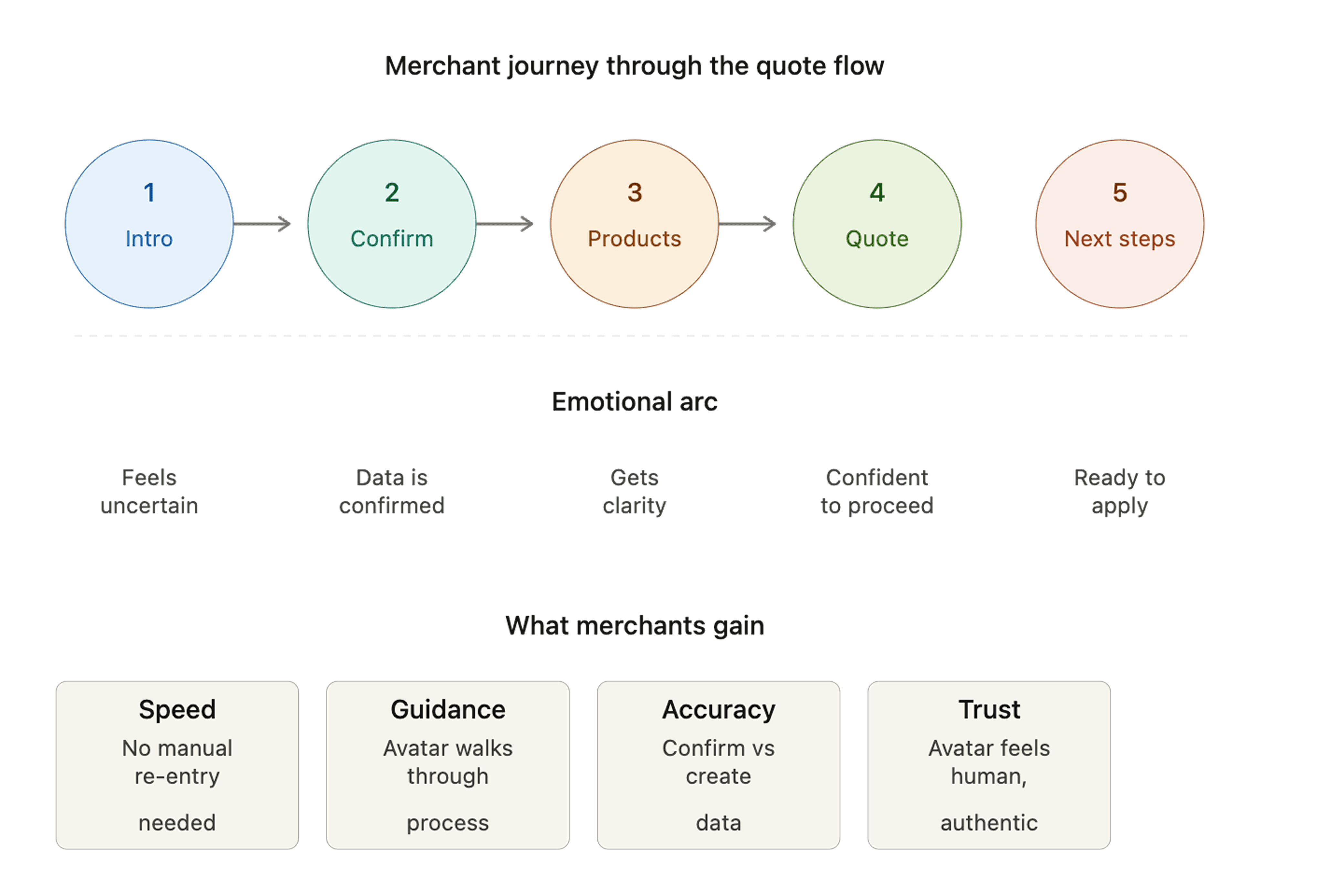
After analyzing the competitive landscape, I collaborated with our lead product designer and product managers to create a storyboard that visualized the entire merchant journey through the AI-assisted quote flow. This wasn't just mapping steps, it was articulating the emotional arc. We defined key moments: where merchants felt friction in the traditional manual process, where they'd feel relief in the AI-assisted flow, and where the AI needed to step in intelligently to guide them. The storyboard became our north star, ensuring every design decision from how the avatar spoke to what data it pre-filled tied back to reducing friction and building trust. It gave the whole team alignment on the story we wanted to tell in the prototype.
Creating the vision
Storyboarding the merchant journey
After analyzing the competitive landscape, I collaborated with our lead product designer and product managers to create a storyboard that visualized the entire merchant journey through the AI-assisted quote flow. This wasn't just mapping steps, it was articulating the emotional arc. We defined key moments: where merchants felt friction in the traditional manual process, where they'd feel relief in the AI-assisted flow, and where the AI needed to step in intelligently to guide them. The storyboard became our north star, ensuring every design decision from how the avatar spoke to what data it pre-filled tied back to reducing friction and building trust. It gave the whole team alignment on the story we wanted to tell in the prototype.
First draft
Exploring interaction tools
Since the concept required voice interaction, I explored different platforms to bring the AI avatar to life. I started with ProtoPie, building an interactive prototype where users could speak to an AI blob and experience the conversational flow firsthand. This helped validate the core interaction model — how merchants would naturally engage with voice guidance. I also created a Figma prototype to map out the visual flow and design system, though it lacked the voice dimension. After testing both approaches, we decided to move forward with Figma for the final prototype — it gave us better control over avatar visualization and was more suitable for demonstrating the concept in a polished demo.
First draft
Exploring interaction tools
Since the concept required voice interaction, I explored different platforms to bring the AI avatar to life. I started with ProtoPie, building an interactive prototype where users could speak to an AI blob and experience the conversational flow firsthand. This helped validate the core interaction model — how merchants would naturally engage with voice guidance. I also created a Figma prototype to map out the visual flow and design system, though it lacked the voice dimension. After testing both approaches, we decided to move forward with Figma for the final prototype — it gave us better control over avatar visualization and was more suitable for demonstrating the concept in a polished demo.
Interaction design
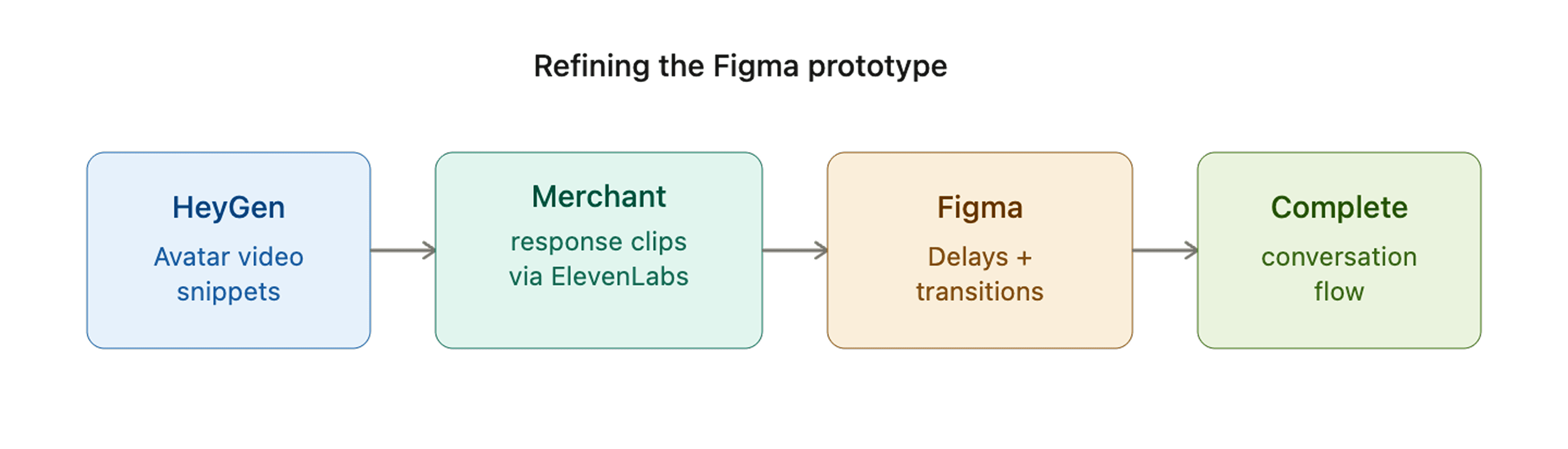
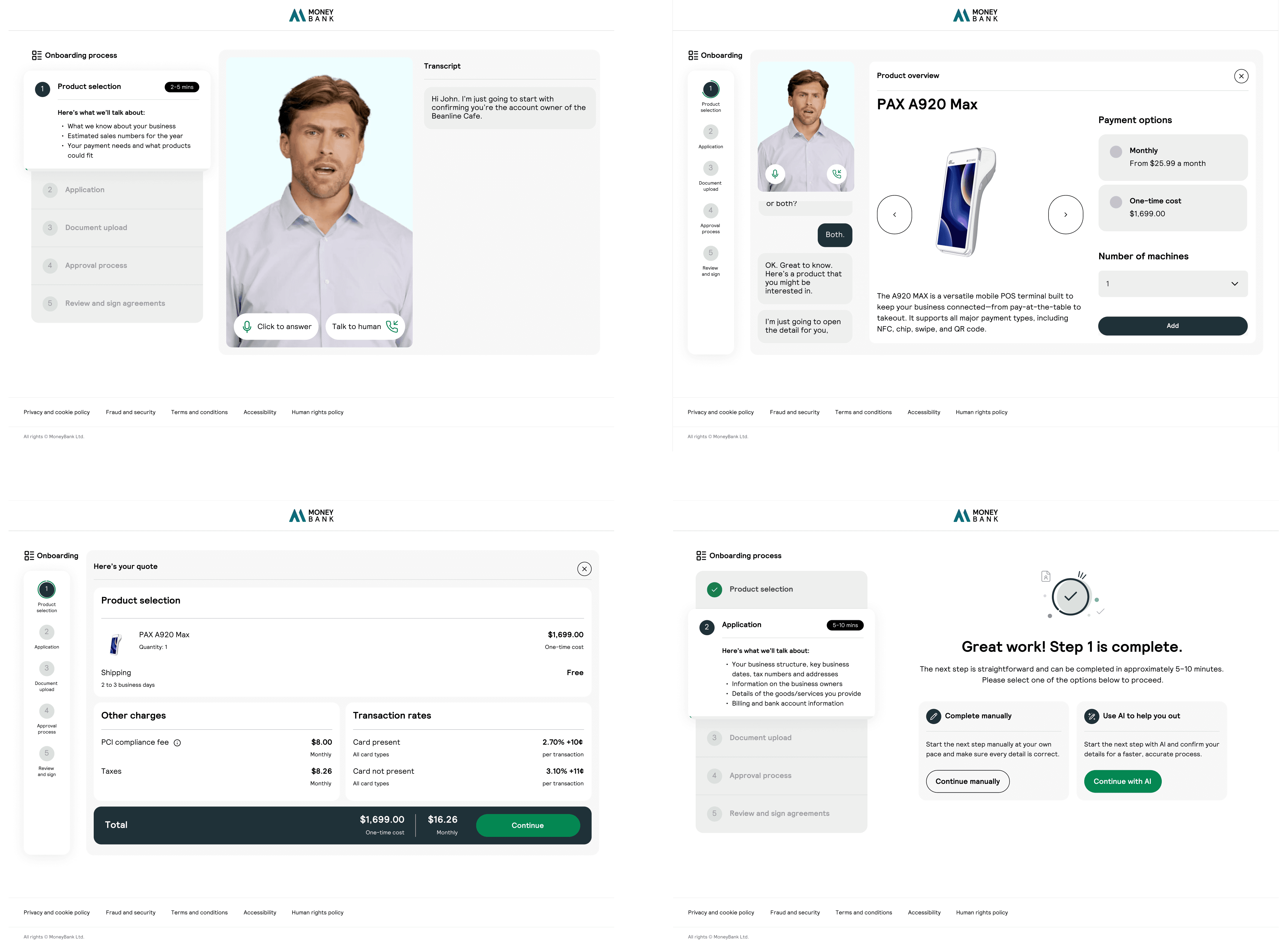
To make the Figma prototype feel like a genuine conversation, I layered three key elements. First, I used HeyGen to generate avatar video snippets, the bank representative answering questions and guiding merchants through the quote. Second, I recorded merchant response clips to simulate real user input. Third, I built deliberate pauses and transitions into Figma using delays and animation timing, creating the rhythm of natural back-and-forth dialogue. Rather than a static wireflow, this approach let stakeholders experience the actual feel of conversing with an AI avatar. The delays mattered — they prevented the interaction from feeling robotic and gave merchants time to absorb information before the next prompt.
Interaction design
To make the Figma prototype feel like a genuine conversation, I layered three key elements. First, I used HeyGen to generate avatar video snippets, the bank representative answering questions and guiding merchants through the quote. Second, I recorded merchant response clips to simulate real user input. Third, I built deliberate pauses and transitions into Figma using delays and animation timing, creating the rhythm of natural back-and-forth dialogue. Rather than a static wireflow, this approach let stakeholders experience the actual feel of conversing with an AI avatar. The delays mattered — they prevented the interaction from feeling robotic and gave merchants time to absorb information before the next prompt.
Impact
Here is what we achieved
Impact
Here is what we achieved
Attracted interest from Mastercard, Fiserv opening partnership and funding conversations
Prototype suggested strong potential to improve merchant conversion through reduced manual effort
Showed potential to reduce completion time by 10-15 minutes
Positioned Pollinate as an innovator in modernizing merchant acquisition